

The field of home automation concerning the “living” aspects of modern homes is extremely diverse from a product perspective. These are devices aimed at making smart the management of some basic aspects of the home related to climate, ventilation, lighting and more. Increasingly popular in the home automation context, motorized roller shutters are an excellent solution in terms of convenience, efficiency, and management of daylight and home temperature.
MOTORIZED ROLLER SHUTTERS: TYPES AND FEATURES
Motorized, electrically driven roller shutters feature a system in which raising and lowering are not done by manual action on the classic strap, but by electrical control generated by a push-button, remote control, or via smartphone. This specific type of roller shutter has the tubular lifting rod, like the traditional roller shutter, but inside is, precisely, the electric motor that gives rise to the two-way movement, while rope and its winder are absent.
These shutters-which differ from each other in terms of materials, shapes, motor power, power supply, and activation system-have a wide range of advantages including theabsence of physical effort to raise and lower the shutter, a pivotal element in the case of particularly fragile users. The elimination of the lifting strap and the winder roller also generates benefits in terms of maintenance (no need for periodic replacements) and the contingency of risks caused by their breakage. The gentler movement of shutters also means that product life tends to be longer, which is not impacted by abrupt closures and openings.
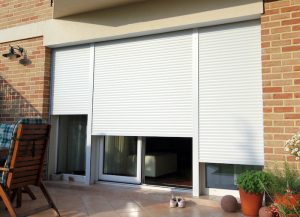
Centralized management of shutters, especially when connected to smartphones or smart speakers, allows them to be operated remotely, increasing the possibilities of use by users. Programmability, increased safety, but also better management of the home climate and thus savings in consumption. In fact, motorized roller shutters, awnings, and blinds can be programmed to close at specific times and keep the house at the right temperature, providing excellent room regulation.
Motorized roller shutters, standards and CE marking
The marketing of motorized roller shutters on the EU market-just like that of any other electrical, radio and electronic product-is subject to theapplication of directives attesting to the devices’ compliance with certain standards, ensuring health and environmental protection for the consumer.
Building components and furniture components of the motorized/electrified type-including the shutters in question-must, among other key aspects, meet the requirements set forth in the Machinery Directive 2006/42/EC and the Electromagnetic Compatibility Directive 2014/30/EU. Directive 2006/42/EC determines the characteristics required to market throughout the European Union, without any constraints, the products-machine defined as “the assembly equipped or intended to be equipped with a drive system other than direct human or animal force, consisting of parts or components, at least one of which is movable, solidly connected to each other for a well-defined application.”

EMC Directive 2014/30/EU, on the other hand, covers any device that is capable of generating electromagnetic disturbances, or whose operation may be affected by such disturbances, by defining levels and standards that allow the normal performance of the product, without unacceptable deterioration of it and its neighboring devices.
More generally,obtaining CE marking on motorized roller shutters and the like-as a “visible consequence of a whole process that includes conformity assessment in a broad sense”-presents a number of specific obligations for the economic operators involved, namely manufacturer, importer and distributor.
In the process of conformity assessment of motorized roller shutters and similar devices – we find key steps such as the drafting of the EU Declaration of Conformity and the implementation of a technical dossier for CE marking. The latter has the function of demonstrating, through documentation, the product’s compliance with the directives in force, and the economic operators concerned are obliged to keep it for ten years. The CE mark, as is well known, needs-to be controlled and affixed visibly, legibly and indelibly-by those involved in the production and marketing process.
Finally, in the event of malfunctions or problems detected on the product, it will be necessary for the figures connected with its marketing and production to put in place all appropriate corrective actions, an important element in demonstrating that they have acted correctly during inspections by the competent authorities.
Per chiedere ulteriori informazioni su questo argomento, scrivere a info@sicomtesting.com
o chiamare il numero +39 0481 778931.